
Tokachidake ski touring: a day on Hokkaido's smoking volcano, above Furano

Updated: Sep 28
Tokachidake is a volcano in Hokkaido, in the far north of Japan, and it is still awake. It rises to 2,077 metres, and on a cold clear morning you can watch it smoke — a thin plume drifting off the summit crater while the Furano valley sits under haze far below. For a ski tourer, it is one of the more honest lines on the island. No lift takes you up. The snow that falls here is the cold, dry powder Hokkaido is known for, and the way to earn it is to put skins on and walk.
This is a page about skinning up Tokachidake and skiing back down it: how to organise the trip, the line itself from the car park to the high point, what fills the days off the snow, and why you want a professional alongside you on a volcano that is neither marked nor asleep.

Skinning up the open flank, the Furano valley far below.
Organise your ski touring stay
Base camp
You do not fly to Hokkaido to ski one hill. Tokachidake sits within reach of Furano, and the sensible plan is to base yourself in the region for several days and let the weather decide where you point the car each morning. The region skis from one area to the next — Tokachi one day, another sector the day after — so the value is in staying put and moving with the snow rather than chasing a single summit. A few nights in one place, hot food in the evening, and the freedom to swap plans when a storm rolls in off the Sea of Japan. The full trip: skiing in Japan.
Ski touring kit
You are self-propelled here, so the kit matters. Wide touring skis to float in the deep stuff, pin bindings, skins, and a set of ski crampons in the pack for the mornings when the track has hardened underfoot. For safety, the standard three that never leave the bag: a transceiver, a shovel and a probe, worn and checked before you leave the car park, plus an airbag pack.
One honest word on conditions. Japan does not run as dense a network of avalanche forecasts as you would find in the Alps, so you cannot simply pull up a regional bulletin and read the day off a screen. You check the weather, you read the sky, and above all you read the snowpack in front of you. That is precisely why it helps to have someone who does this for a living — more on that further down.
Routes on Tokachidake
The climb
The line starts high, at the car park at the end of the road that climbs up above Kamifurano. From there it is roughly two hours on skins, first through a birch forest at a steady, patient gradient — the kind of angle you can hold a conversation on. The trees thin, and above the treeline the character of the day changes completely. The terrain opens out, the wind has its say, and you cross the flank on a series of kick turns, eyes up. Nothing technical, but exposed enough that you want to be paying attention.
The high point and the descent
After around three hours you reach the high point. On a clear day it is worth a minute before you rip skins: the massif's smoking craters on one side, the Furano valley laid out under a cold haze on the other, the light flat and northern.
Then you turn round and ski it. Long turns in cold, dry snow — the kind of powder that floats under the skis and blows up over your thighs on every arc. Lower down you drop back into the birches and ski the open forest all the way to the car park, weaving between the trunks with the snow still coming over the tips. Hokkaido skiers have a word for this snow: Japow, a run-together of "Japanese powder", and here it earns the name.
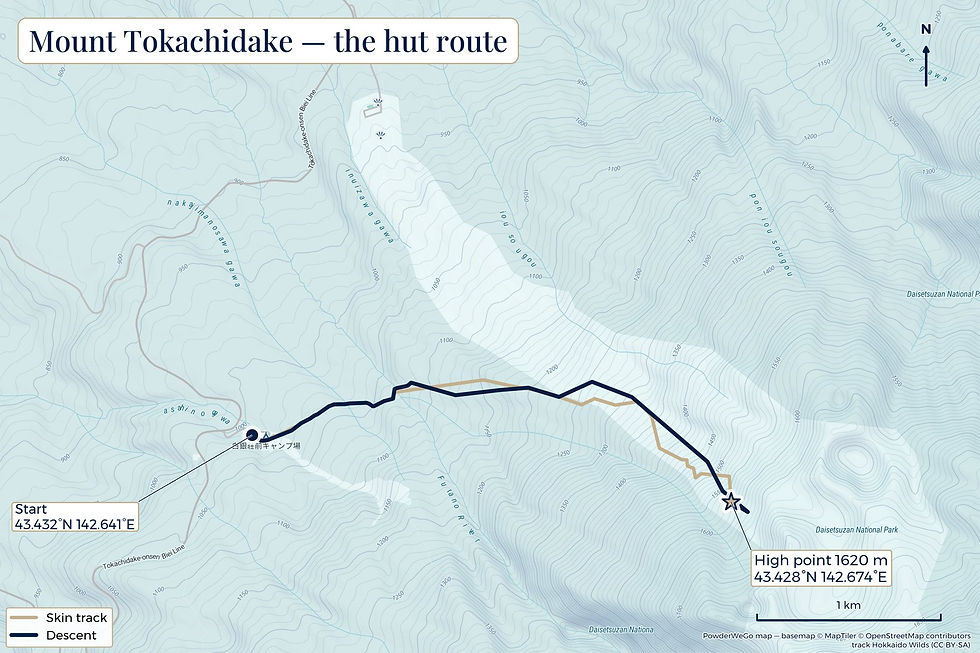
GPS route: skin track, high point and descent.

The surroundings: nearby towns and the route area.

The region within Hokkaido, with its ski resorts.
What to do off the snow?
Exploring the Furano region
Tokachidake is one line among several. Over the following days, the ground around the Tokachi massif and out towards Asahidake — Hokkaido's highest peak — holds plenty of good touring, and the whole point of a Hokkaido trip is exactly this: moving from area to area, following the snow rather than a fixed itinerary. If you want the lay of the land before you come, we have written up the touring around Furano and, further west, the powder on Niseko's Annupuri.
Unwinding after the ski
The evening belongs to the onsen. These are volcanic hot baths, fed by the same geology that keeps Tokachidake awake, and after a day on skins there is nothing better than a tired body sinking into the water while snow falls on the other side of the glass and steam lifts off the surface. This is the real Hokkaido après-ski — no bar, no noise, just heat and silence. From Furano you can carry on to other corners of Hokkaido or loop back to Sapporo, planning the drives around the next front and where the snow is falling.

Through the open birch forest in the sun, on the way up.
Going with a guide
Tokachidake is skied off any marked run. There is no piste, no patrol, no rope to stay inside — this is volcano touring terrain, and the mountain decides the terms. For that, you want a mountain professional: a qualified off-piste ski instructor or an IFMGA/UIAGM mountain guide, depending on the day's terrain. Someone who knows the sector, reads the snowpack morning by morning, and — the part that matters most — knows when to turn the group round and say no.
At PowderWeGo we organise adventure ski trips to Hokkaido from start to finish: the guiding, the logistics, and the choice of slopes day by day according to the snow. We never promise zero risk — no one honestly can, in the mountains — but we do everything so that the only thing left for you to think about is the descent. To build your trip, let's talk.
Frequently asked questions
Do you need to be a strong skier?
You need to be a competent off-piste skier — at home in powder and on ungroomed slopes, both up and down. You do not need to be an alpinist, and there is no climbing or rope work on the standard line. But you do need to ski a full day under your own steam, with real self-reliance in touring terrain, carrying your kit up and skiing it down.
When is the best time?
The heart of the season runs from mid-January to mid-February, when Hokkaido gets its coldest, driest and deepest snow. December and March give fine days too — a little warmer, a little more variable — but if you want the snow the island is famous for, aim for those four weeks in the middle of winter.
Can you ski Tokachidake solo?
We would advise against it. This is a still-active volcano, unmarked, and without the dense avalanche-forecast network you would lean on in the Alps. A professional who knows the sector changes everything — both for staying on the right side of the risk and for finding the best snow of the day, which is rarely where you would guess on your own.


Comments