
Beyond the ropes at Niseko: the gates to Hokkaido's lightest powder

Seven in the morning, and the chairlift still creaks under a skin of frost. Ahead of us, a rope strung across the slope, a sign, and a patroller in an orange shell knocking snow off his gloves before he reaches for the padlock key. We wait. Nobody says much. He looks at the sky one last time, then he opens it. The gate is open. Behind it, the birch forest drops away in an easy pitch, and the snow hasn't been touched since dark — twenty, maybe thirty centimetres that fell in silence while we slept under the futon. We drop in one by one through the white gap, and the world goes soft and fast at the same time.
That is what skiing in Niseko really means. Not the groomers everyone knows, but what sits just past the rope — the terrain the resort opens a little at a time, when the mountain allows it.

One massif, four faces
We say "Niseko" as if it were a single resort. It isn't. Niseko United links four interconnected sectors of one massif under a single lift pass: Grand Hirafu, Hanazono, Niseko Village and Annupuri. Four gateways, four moods — and one summit they all share, Mount Niseko-Annupuri.
That shifting quality is what makes the mountain feel alive to anyone chasing snow. In the morning the wind can hammer the Hirafu side and leave Annupuri sheltered; by afternoon it flips. You work your way around the peak the way you'd work around a problem, looking for the face where the snow stayed dry, where the wind never crusted the surface. Moving from one sector to the next isn't about ticking boxes on a map — it's about following the snow.
Grand Hirafu, the biggest and busiest, opens the most terrain up high. Hanazono, facing northeast, keeps its birches out of the sun and away from the crowds. Niseko Village falls in wider, more open pitches. Annupuri, to the west, carries a stubborn reputation for the best-spaced trees on the hill — the kind you ski top to bottom without ever easing off.

The gates, or freedom kept in good hands
Here is what makes Niseko unlike anywhere else, and what the resort guides rarely spell out: off-piste here isn't a grey area. It's a system.
The famous Niseko Rules draw a line that's both firm and generous. Ducking a rope anywhere you please is off-limits — but all around the ski area, marked gates give you fully legal access to the backcountry, to the terrain the patrol judges skiable. Those gates open and close with the day's avalanche conditions. A summit gate releases the top bowls when the weather allows. The rest of the time it stays shut, and no one argues.
You could read that as a constraint. It's the opposite. That system is the luxury of terrain run by people who know it by heart. When a gate opens, someone has already read the slope, tested the snowpack, weighed up the overnight wind. You ski vast powder with a professional reading of the hazard behind it. Few places on earth hand you this much untracked space inside such a clear framework.
The official rules and the current gate list live on the resort's mountain-safety site — a document worth rereading every season, because it changes. For the avalanche picture, the Japan Avalanche Network publishes bulletins for the region. It's the first read of the morning, before the coffee.
And this is where a guide earns their place. Picking the right gate for the day's wind is a craft. Strong westerly? You steer clear of the exposed ridges where wind slab builds, and head for the leeward sectors where the snow stays cold and light. Low cloud? You stay in the trees, where the terrain still reads through flat light. A guide doesn't follow a set track — they read the massif in real time, gate after gate.

Why the snow stays this dry
There's a physical reason behind all of it, and it explains why January in Niseko feels like few other places. Cold air off Siberia crosses the Sea of Japan, picks up moisture on the way, then slams into Hokkaido's high ground and unloads it as snow. Dry, light snow that often falls overnight and buries yesterday's tracks.
The cold does the rest. In January the thermometer swings between −12°C and −4°C, often sitting steady around −10°C. At that temperature the powder never takes on water, never crusts, never packs down. It stays the down you lift off the ground with every turn. According to the resort's own figures, something like fifteen metres of snow falls across a season — a number to quote with care, but one that tells you the order of magnitude. The heart of winter, the window we aim for, runs roughly from 15 January to 15 February.
We've laid out the full mechanics of this in our piece on why Hokkaido's snow is the best in the world — the ideal read before you go. The official climate data comes from the Japan Meteorological Agency.
Yotei across the valley, like a lighthouse
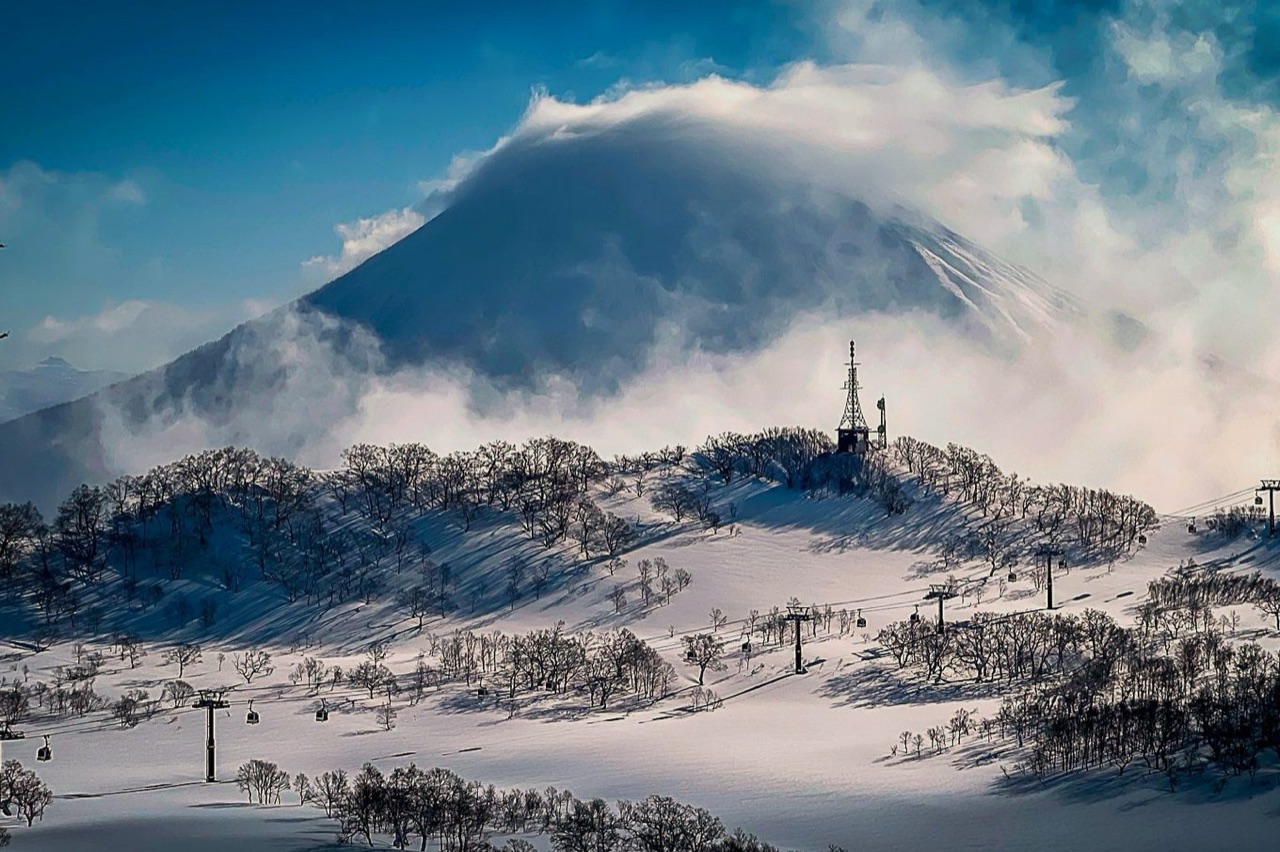
There's a moment, every morning, when you stop. You turn around, and there it is: Mount Yotei, 1,898 metres, that near-perfect cone they call the Fuji of Hokkaido. From the Niseko slopes it fills the whole horizon. You look at it as a marker, a presence — and for some, a pull. Its lone silhouette can be climbed on skins by anyone wanting to go beyond the ski area; we've given it its own ski touring route up Mount Yotei.
But even without climbing it, it shifts the day. Skiing an open bowl with that white volcano framed in front of you is the kind of image that stays. You forget the cold, the burn in your thighs. You look, then you push off again.
Skiing Niseko the right way
Niseko isn't the end of the earth. From Tokyo, a flight of just under two hours puts you down at New Chitose, then a two-and-a-half to three-hour road transfer brings you to the massif. We've mapped the whole journey in our guide to getting to Niseko on the island of Hokkaido. Getting there is simple; it's reading the terrain that takes experience.
That's why we build the Ski Safari Hokkaido around January — PowderWeGo's month in Japan. A safari in small groups (three parties of six at most), led by a guide who knows the gates, the winds and the faces of each sector. A ski level of 3/5 and modest fitness are plenty: this is freeride and ski touring, not feats of endurance. Around 800 metres of climbing a day, snow up to the thighs, and when evening comes, the onsen steaming in the cold, the ryokan, a table at an izakaya. The pure hit of it, without the hassle of organising a thing.
Niseko sits inside a wider picture we cover in our overview of off-piste skiing across Hokkaido. But if you were to ski a single massif in Japan, this one — with its four faces and its gates — is a hard opening act to beat.
The Japanese winter season is well documented, on the practical side, by the Japan National Tourism Organization. For the rest — dates, a place, a quote — let's talk directly.
Fancy skiing Niseko in January? Take a look at the Ski Safari Hokkaido and get in touch to hold an option on the next dates.


Comments