
Skiing in Iceland: the level, the season and the kit for skiing down to the fjord

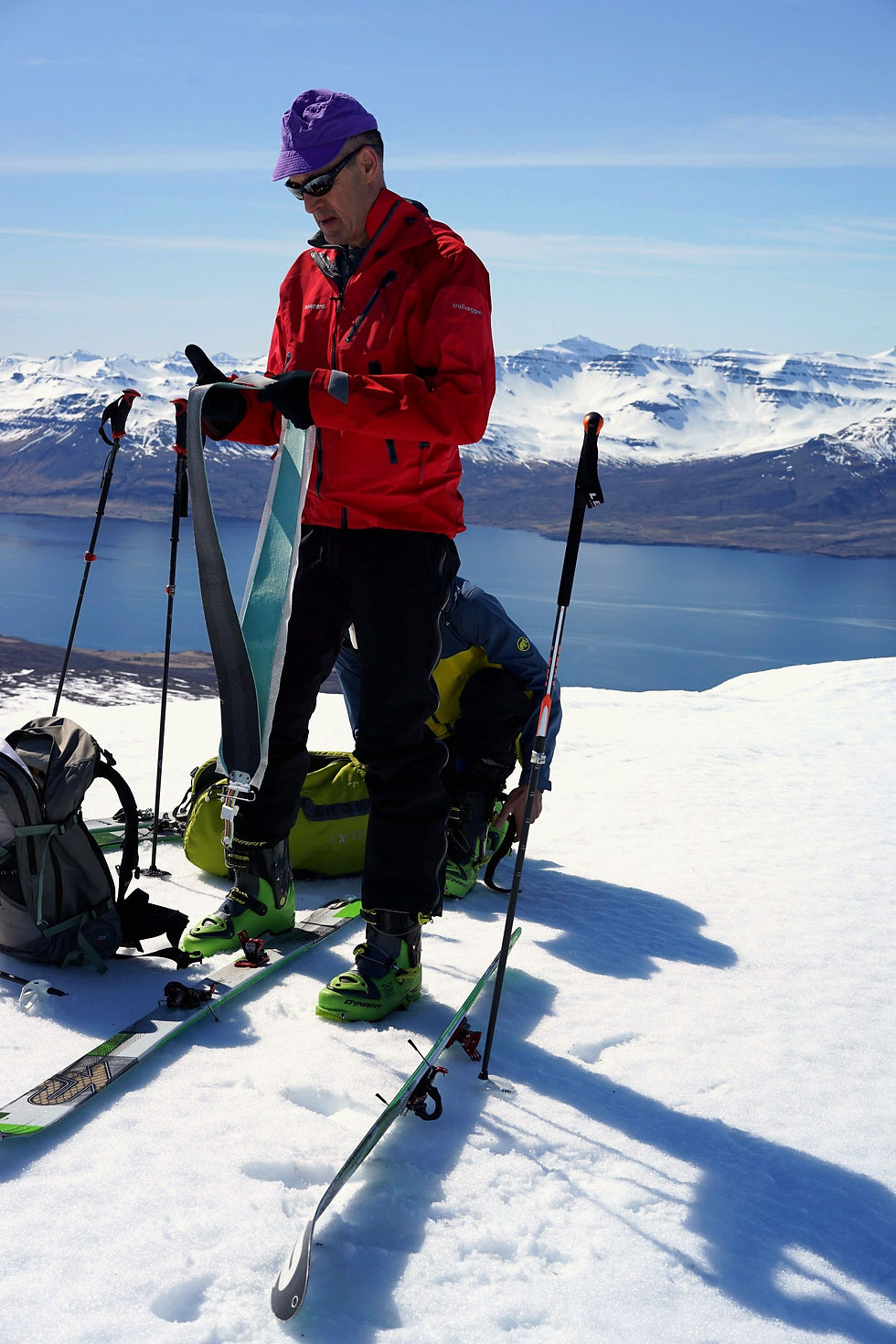
Morning on the Tröllaskagi: coffee steaming at the lodge, skins tucked in the pack, the helicopter warming its turbines. A few minutes later it sets you down at the top of a slope that falls away towards a fjord still half asleep. That is skiing in Iceland on a heli-assisted touring week: the helicopter takes you to the first line, and the rest of the day unfolds on skins.
Before booking, the same three questions always come up: the level, the season, what goes in the bag. Here is enough to tell, in five minutes, whether ski touring in Iceland, done this way, is for you.

Gauging your level: a few clear markers
One question matters more than any other: do you enjoy skiing off-piste in deep snow, for several hours at a stretch?
A day means around 800 metres of skinning, then descents of 400 to 800 vertical metres depending on the zone: north faces, wide couloirs, boreal forest, and runs that finish at the fjord's edge. On fitness, you are comfortable with a moderate effort over several hours. On skiing, you have a solid off-piste level, some ski touring behind you, and you love linking turns in powder. Already skiing off-piste, and tempted by the skin track? You are in the right place.
Every morning one of our mountain professionals chooses the day's route according to snow cover, aspect and the avalanche bulletin from Veðurstofa Íslands, the Icelandic Met Office. On the mountain, the final word is theirs. You ski four to a professional, two groups at most.
Thanks to the skins, we ski in almost any weather: on the days the helicopter stays on the ground, the day carries on as a ski tour.

A typical day on the Tröllaskagi
Breakfast at the lodge, the day's briefing and a check of the safety kit. The helicopter drops you at the top of a first slope. First descent to a flat spot, then skins back on and up towards the next line. Lunch carried with you, eaten on the mountain. The afternoon strings climbs and descents together to suit the group and the snow, before a last run that often ends at the fjord's edge. Back to the lodge for the sauna, the hot tub and a dinner cooked by the chef. Six days of skiing across a stay of seven days and six nights.
Unsure of your level? Write to us before you sign up and we will look together at whether this programme suits you. For the wider picture, read what level you need for an adventure ski trip, and find the week's programme on our page for skiing in Iceland on a heli-assisted touring week.
Iceland in March and April
The season runs across two months, March and April. By early April the light lingers and the snow is often at its best on north-facing slopes.
The calendar, the light and the snow month by month are waiting in our piece on when to go to the Tröllaskagi. For safety and conditions on the ground, check SafeTravel Iceland.

The bag: what we provide, what you bring
The safety kit is on us; the skis and clothing are yours to bring.
What PowderWeGo provides:
Safety kit · avalanche airbag pack, transceiver, shovel and probe
One helicopter drop · per day, further drops subject to availability
Transfers · Akureyri airport, both ways
Lunches · carried onto the mountain each day
Lodge · full board, dinners by a chef, sauna and hot tub
What you bring:
Skis, boots, bindings · your touring set-up
Ski width · minimum width 100 mm recommended for deep snow
Clothing · your ski touring layers
Helmet · your own, in your size
Insurance · travel and repatriation, compulsory, to be provided before departure
The choice that matters most is ski width. From 100 mm underfoot, you float through deep snow and the long spring descents become pure pleasure. A special diet or an allergy? Mention it when you book and the chef will take care of it.
The flight to Akureyri and the access details are on the trip page. The terrain and the full story are in our piece on heli-assisted ski touring on the Troll Peninsula, from summit to ocean.
In short
Level: a solid off-piste skier at ease in deep snow, around 800 m of skinning a day, descents of 400 to 800 m.
Season: March and April.
Provided: avalanche airbag pack, transceiver, shovel, probe, one helicopter drop a day, lodge on full board.
To bring: skis (minimum width 100 mm recommended), boots, bindings, helmet, clothing, insurance.
Your questions before you book
You mostly ski in resorts: is your level enough?
Yes, if you happily head off-piste and already have a few ski tours behind you. You need to link turns in deep snow and hold a moderate effort over several hours. In doubt? Write to us and we will look together at whether the programme suits you.
What is the right season for skiing in Iceland?
March and April. In early April the snow is often at its best on north-facing slopes. The calendar and the light are covered in our piece on when to go to the Tröllaskagi.
What does PowderWeGo provide on site?
The full safety kit (avalanche airbag pack, transceiver, shovel and probe), one helicopter drop a day, transfers from Akureyri airport, lunches carried onto the mountain and the lodge on full board, with sauna and hot tub. You bring your skis, boots, bindings, helmet and clothing.
What ski width should you plan for?
A minimum width of 100 mm underfoot is recommended to float well in the deep snow of the Tröllaskagi.

A well-packed bag, and the mountain does the rest. Before every descent, our professionals show you where the snow is finest that day. Skis wide enough, the safety kit on your back, and you ski down to the fjord with a clear head. The PowderWeGo team
The week's itinerary, what is included and the price are in our piece on a week of heli-assisted touring on the Tröllaskagi. When you feel ready, it all begins on the Iceland heli-assisted ski touring trip page. To talk through your level or your plans, write to us.


Comments