
In Lofoten in March, winter snow still holds and the day runs twelve hours

Quarter past seven in the morning, the first coffee steaming in the rorbu, and outside it's still dark. Not the polar night of January — this is a hesitant dark, a blue that climbs slowly over the Vestfjorden. By the time the skis are loaded into the minibus, the ridgelines have turned pink. This is March in Lofoten. You click in under the low, raking light of a sun that never climbs far, and you come down in the evening with the day still bright in your eyes. In between, the snow is winter's own — cold, dry, exactly what you came for.
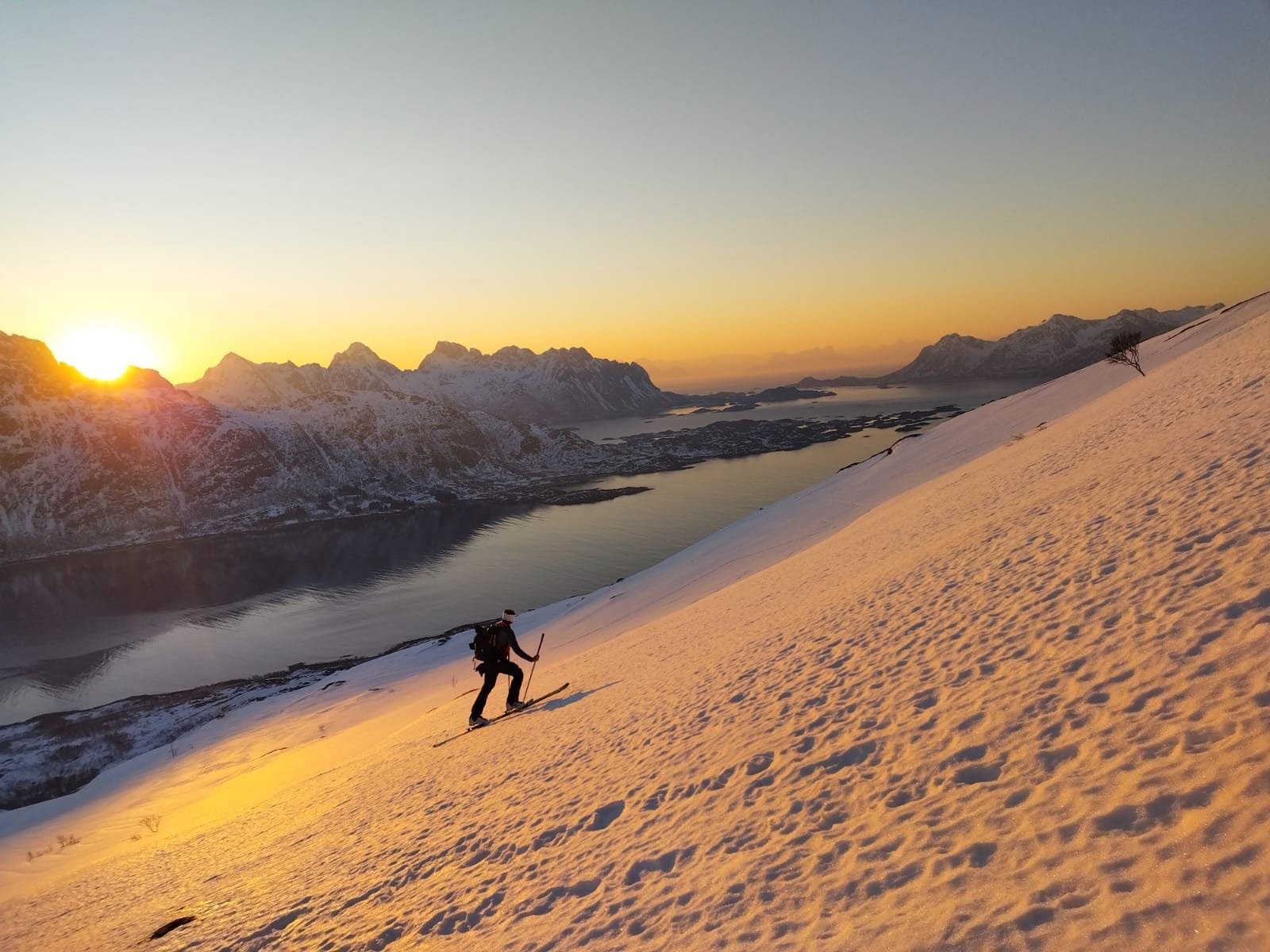
The month that hands back four hours of daylight
The first thing that strikes you in Lofoten in March is how fast the day comes back. On 1 March, Svolvær gets 9 hours 45 minutes of daylight — the sun up around 7.20am, down just after 5pm. By the 31st it is 13 hours 44 minutes, sunrise near 5.30am and sunset close to 8pm once the clocks have gone forward. Something close to four hours gained in a month, about eight extra minutes of light every morning. You walk into March with a short winter day and walk out with something close to spring.
The equinox falls on 20 March: day and night level, twelve hours each. But the number only tells half of it. Up at the 68th parallel, above the Arctic Circle, the sun stays low on the horizon even at its peak. The light never falls straight down: it comes in low, throwing long shadows across the snow well into the afternoon. For skiing that's a gift: the terrain reads beautifully, every ripple in the snowpack stands out, and the evening light takes an age to fade.
We've mapped how that light shifts month by month across the whole High North in our calendar for Arctic ski touring. March holds a place of its own in the season.
Underfoot, winter hasn't let go
This is where March earns its keep, and where it pulls ahead of April: the snow stays wintry. Temperatures in Svolvær hold low and steady all month — average highs edge up from 1.7°C to 2.8°C, and the lows stay below zero, between −2.8°C and −1.7°C. Enough to keep cold, dry snow up high, without the deep continental freeze you'd find at the same latitude in Siberia.
The Gulf Stream does most of that work. Lofoten sits under a subpolar oceanic climate, tempered by the current — the sea itself stays around 5°C in March. So the cold stays manageable: sea on one side, powder on the other.
An honest word on snowfall: it thins out as the month goes on — the 31-day total drops from around 17 cm in early March to roughly 10 cm by the end. Overnight snow isn't the point here. What makes the skiing good in March is the pack already in place, kept crisp by the cold and redistributed from one aspect to the next by the wind.
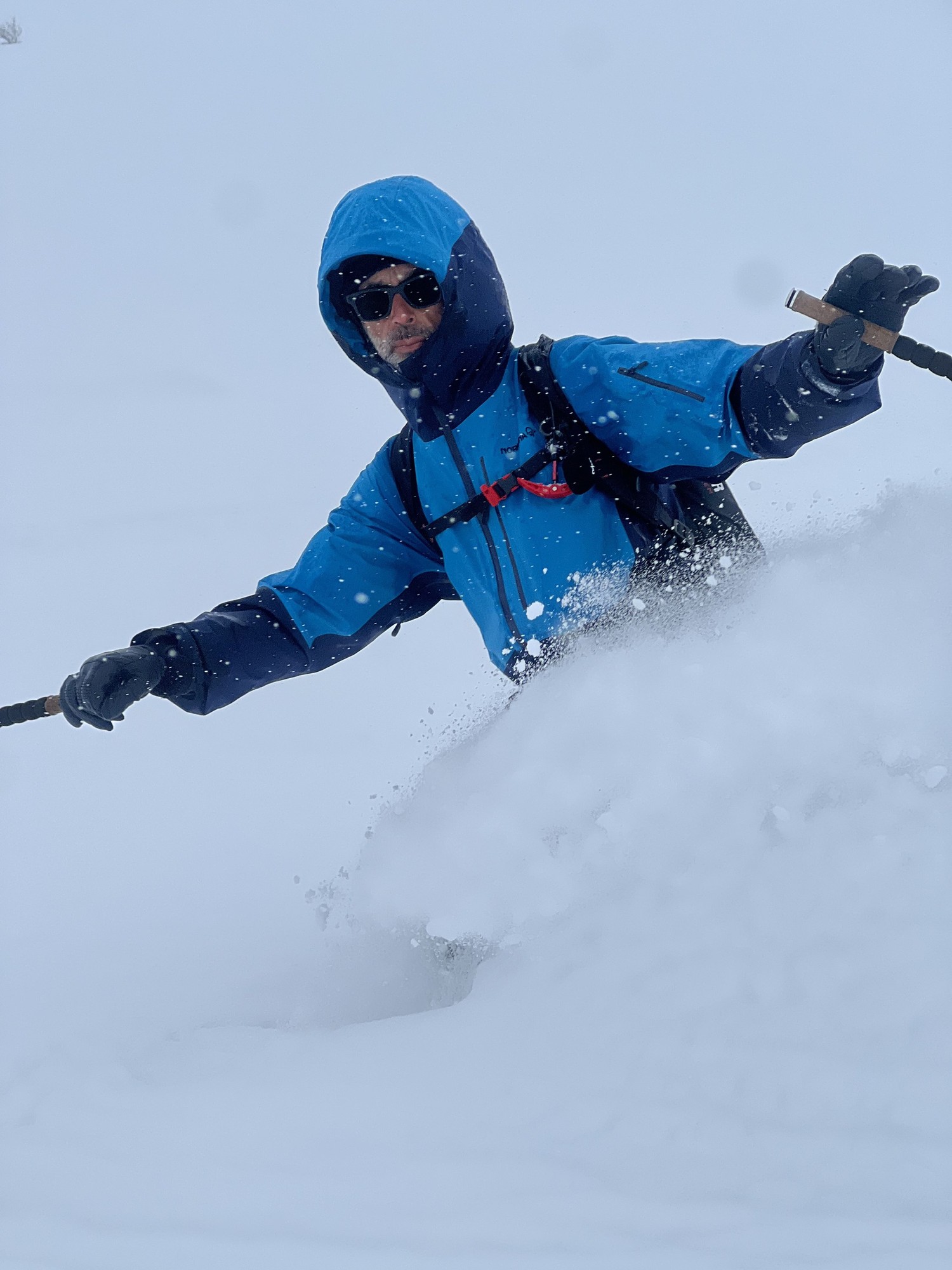
The grey sky is part of the deal
Best say it plainly: the Lofoten sky in March is often overcast — cloudy or mostly cloudy 75% of the time early in the month, still 69% by the end. The chance of a day with precipitation eases from 42% to 35%. There's no point hiding that behind a postcard.
Here's what matters, though: a grey sky doesn't spoil a day's skiing in Lofoten. The snow is there, the slopes are there, and the terrain skis fine under a low ceiling. When a window opens — and it always does eventually — the contrast between the dark sea, the white summits and the shaft of light coming through is something else. You learn quickly to work with the sky, to catch the day's window, to switch islands tomorrow if one aspect is in the cloud. That's exactly where the format earns its place: a single base in fjordside rorbuer, a private minibus, and a different island every morning to suit the weather and the snow.
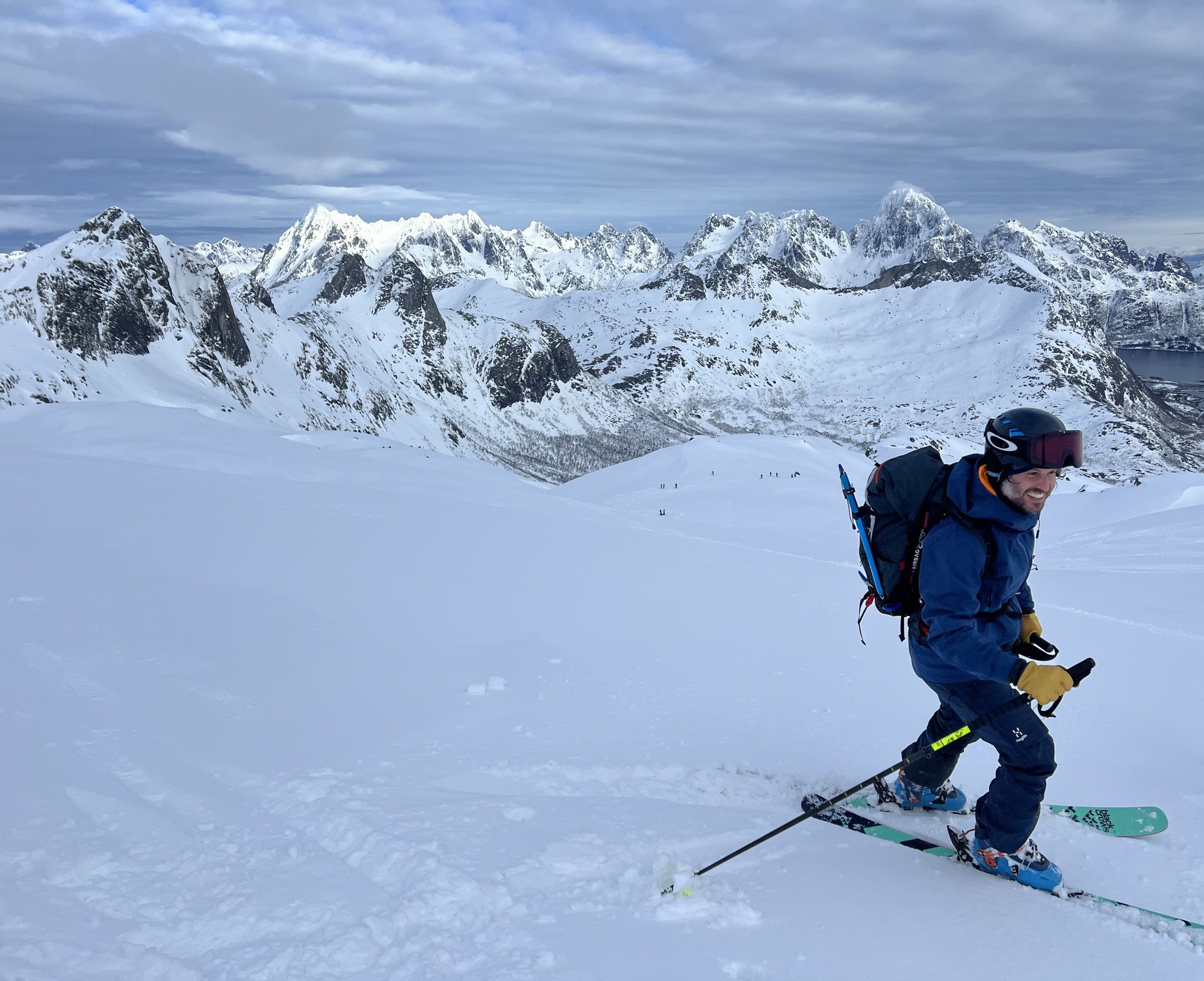
For a concrete sense of this terrain — where you click in almost at sea level — our routes around the Trollfjord give a clear picture of the climbs and the slopes.
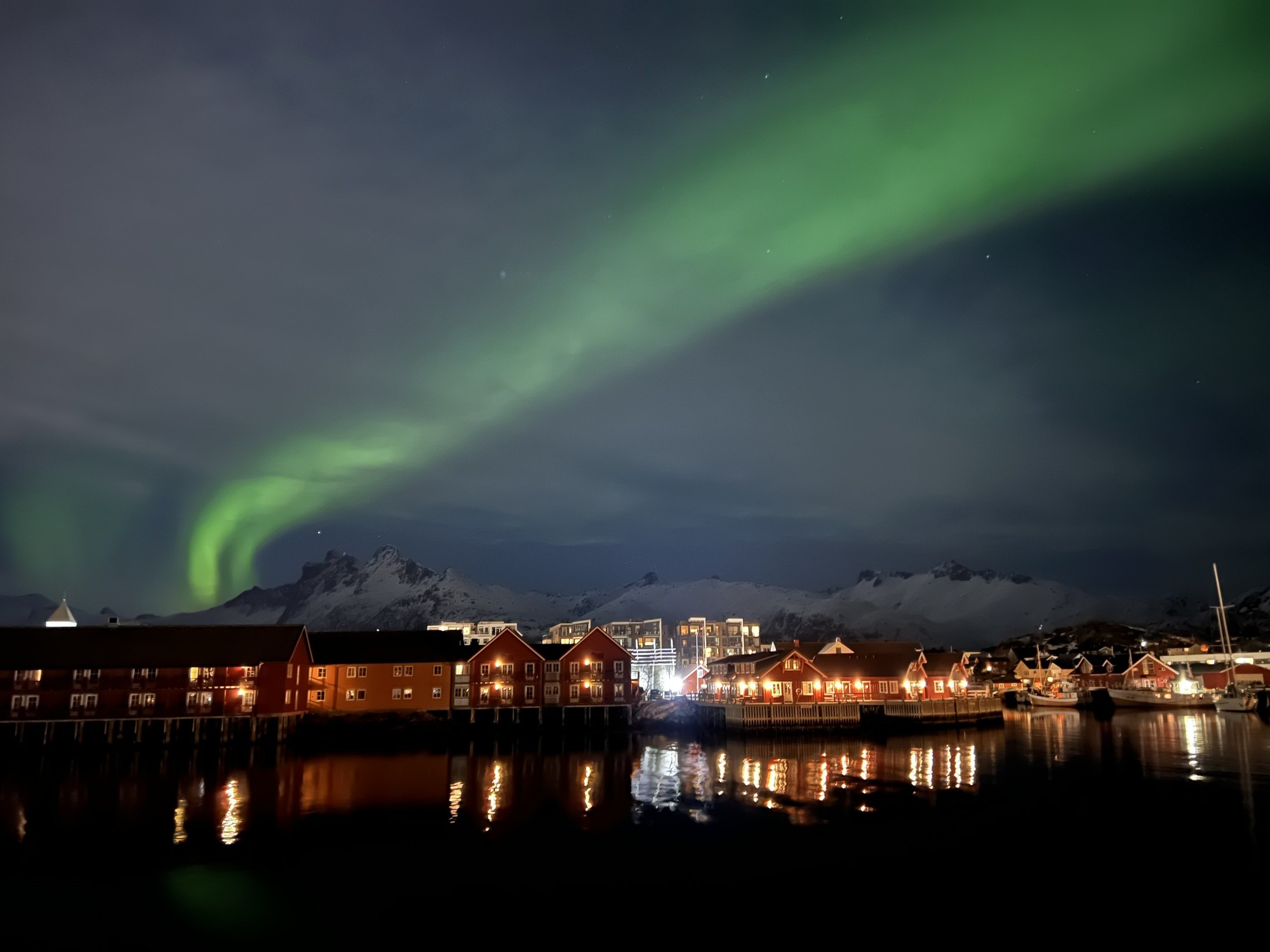
The aurora, when the night obliges
March has something few ski months can claim: it's one of the months when the northern lights are statistically at their most active. The equinox effect stirs up geomagnetic activity, and March ends up level with September–October at the top of the season — as documented by the Norwegian Centre for Space Weather at the University of Tromsø.
What March has over April is that the nights stay dark enough to see them. According to Visit Norway, the aurora season in Northern Norway runs from early September to mid-April: March lands right in the sweet spot, before the lengthening day finally drowns out the night sky.
One caveat, and it's a big one: nobody promises an aurora. You need a clear sky and a bit of luck. Given the cloud cover we've just talked through, it's never a given. But when it does happen — from the rorbu jetty, skis stowed, a beer in hand — nobody goes to bed early.
A day, from coffee to nightfall
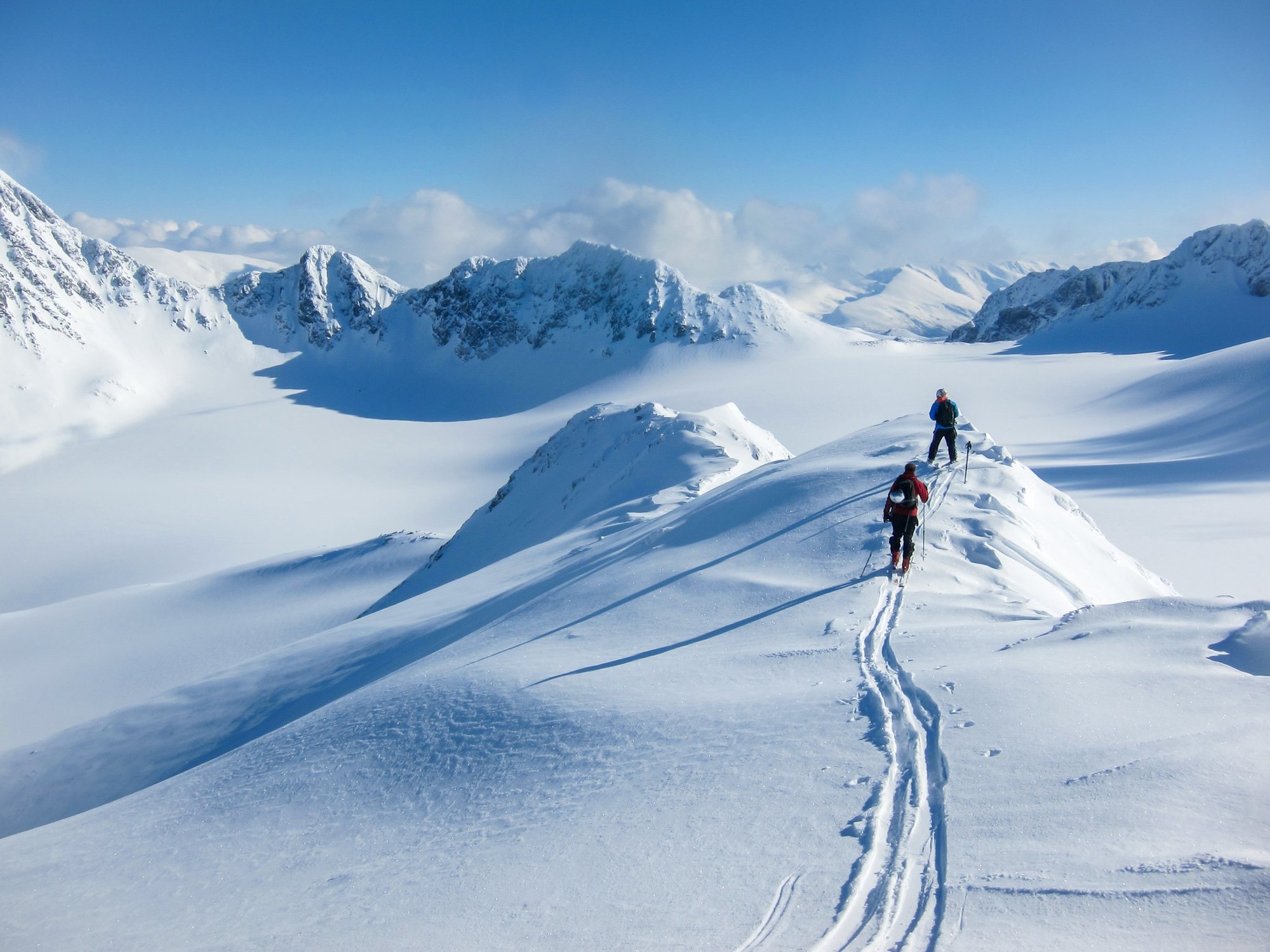
Morning: coffee in the fading dark, skis in the minibus, off to the day's island. You click in almost at sea level, often on a white sand beach with the fjord lapping at it. The climb goes in one push: between 700 and 1,000 metres over the day, up to a summit that rarely tops the thousand-metre mark — the highest point in Lofoten, Higravstinden, only just clears 1,100 metres. No glacier, no mountaineering ground. Real skinning, real descents, sea level to sea level.
Up top: the raking light, sea all around, the neighbouring peaks poking out of the cloud. Then the descent runs down to the fjord's edge, steady and long. Evening, back to base, and for anyone who wants it, the floating sauna on the harbour — a Norwegian ritual that sorts your legs out before dinner.
The level you need is well within reach, but you'll want to ski spring snow as happily as powder and to sustain a decent climb. We talk about that plainly in our guide to the level for adventure skiing.
Reading the snowpack, every single day
Skiing off-piste in Lofoten in March means skiing on a winter snowpack, with everything that implies for avalanches. The good news is that the region is covered by a daily bulletin. The Norwegian service Varsom / NVE publishes one every day before 4pm for the "Lofoten og Vesterålen" region, from 1 December to 31 May. We read it every evening, adjust the next day's plan, and pick the island and aspect accordingly.
For kit, the full quartet comes with the trip: airbag pack, transceiver, shovel and probe. Wind slab is the main thing to watch on this terrain, scoured as it is by the sea winds — all the more reason to read the bulletin and follow the guide. We've written a whole piece on that habit of reading the snowpack, and on knowing when to turn back.
The month at a glance
Daylight · from 9 hours 45 minutes on 1 March to 13 hours 44 minutes by the 31st — about eight more minutes every morning; equinox on 20 March.
Temperatures · average highs 1.7–2.8°C, lows between −2.8 and −1.7°C. Subpolar oceanic climate, tempered by the Gulf Stream.
Snow · still wintry, cold and dry; snowfall thins as the month goes on; quality carried by the pack in place.
Sky · overcast 69–75% of the time — you work with it and catch the windows.
Aurora · March among the most active months, nights still dark enough to see it. Never guaranteed.
Format · 8 days including 6 to 7 of skiing, single rorbuer base, a different island each morning, 700 to 1,000 m of climbing a day.
Questions people ask us
In March, does the snow hold, or is it already spring? March still gives you winter snow: temperatures stay low all day and the cold preserves a dry pack up high. Spring snow, more transformed, tends to arrive in April. That's a big part of what makes March so good for off-piste skiing here.
Will we see the northern lights? Maybe. March is one of the most active months of the season, and the Lofoten nights stay dark enough to pick them out. But you need a clear sky and a bit of luck: no aurora is ever promised.
And the grey days? The sky is often overcast, that's a fact, but the skiing is fine under a low ceiling, and switching islands each morning lets you chase the best aspects and the clear windows.
Do I need a very high level of skiing? You need to be comfortable off-piste, able to descend in powder and transformed snow alike, and to sustain a skin track of several hundred metres. No mountaineering involved: no glacier, no climbing. You click in almost at sea level.
March or April? March for the most wintry snow and aurora still visible; April for longer days and softer spring snow. PowderWeGo runs departures in both months.
Boris's take
"What I love about March in Lofoten is that tipping point. You're still clicking in on cold winter snow, and in the evening the day just keeps sinking down over the fjord. Some weeks you get the grey, so you go and find the open aspects and ski good snow anyway. And then one evening the sky clears, the aurora goes off, and that's when you understand why you keep coming back. It's an honest month: I won't promise blue skies every day, but I'll promise real snow and real light." — Boris Malesset, founder of PowderWeGo, off-piste professional since 2001.
Fancy skiing Lofoten while winter and the light still overlap? Discover our Lofoten ski safari, or get in touch to sort out your dates.


Comments