
Off-piste skiing from Val d’Isère to the Lofoten Islands: one way to ski

What is off-piste skiing? It is skiing beyond the groomed, marked runs, in natural snow, on terrain nobody controls for avalanches. For us it starts in a Val d’Isère bowl the morning after a storm and carries on to a Lofoten ridge dropping into the sea. Two places thousands of kilometres apart, skied with you in the same way: the snow read every morning, the climb on skins, then the run you have been looking at from the summit.
Val d’Isère, where it all starts
Everything begins in the Tarentaise. Boris Malesset, who founded PowderWeGo, has skied off-piste professionally since 2001 and has worked in Val d’Isère since 2005; the PowderWeGo ski school opened there in 2022. The habits that travel with us everywhere were formed on those slopes.
A day of off-piste skiing in Val d’Isère starts before the first lift. We check the day’s bulletin, the overnight wind, which aspects took the sun the afternoon before. Only then do we pick a sector. Everyone carries an avalanche airbag pack, transceiver, shovel and probe, and the transceiver check happens at the start, before the first turn.
Then comes the snow. An untouched bowl, skis sinking in, powder rising to your knees. On exposed slopes the group skis one at a time and regroups in a safe spot, where the instructor is waiting.

Skins: the thread that ties it all together
In Val d’Isère the lifts do much of the work, and a few minutes on skins often reach a side valley nobody has tracked. That is the first step towards ski touring, and it matters most for what comes next: fitting your skins, finding your pace, learning the kick turn on a steep slope.
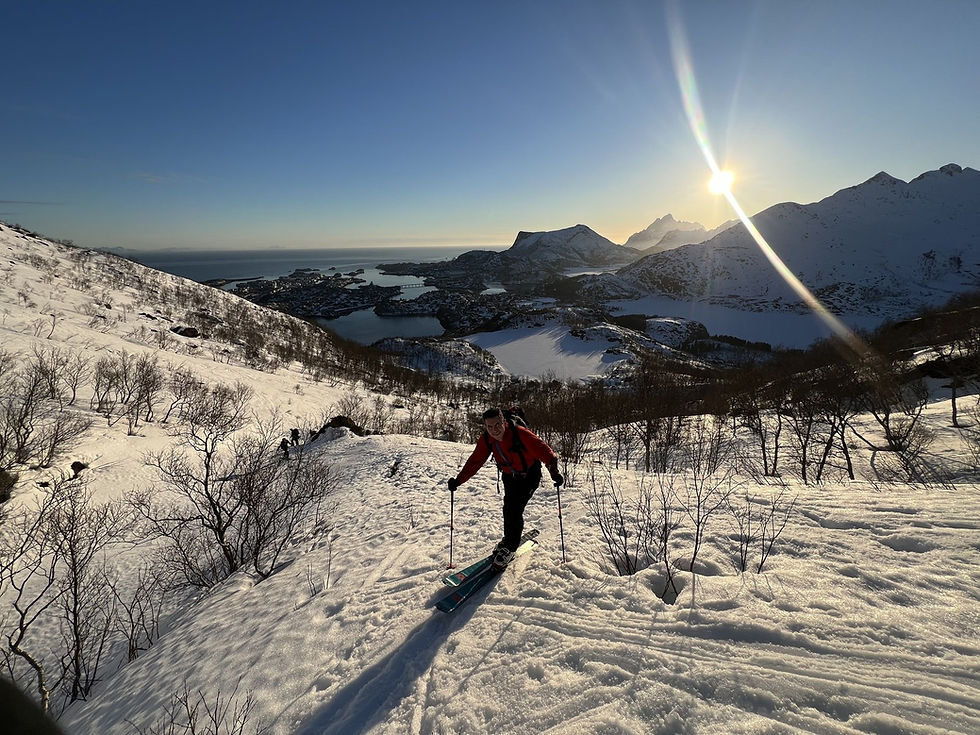
In the Lofoten Islands that same movement fills the whole day. You often set off from the shoreline, skins on, the track climbing through birch trees before it reaches the ridges. It goes quiet; all you hear is the hiss of skins and the breathing of the group. At the top the sea is everywhere, and the descent takes you back down to it.
Reading the snow, here and there
An Alpine snowpack and an Arctic island snowpack have little in common. The method travels with us all the same: the day’s bulletin, observation on the ground, the choice of route, then a decision at the foot of every slope. The European avalanche danger scale, from 1 to 5, gives us a shared language from one country to the next.
The rest comes with time, and from people who pass it on. Our days on the snow are also lessons: digging a snow pit, probing, understanding why a sunny slope is better left until later. Knowing when to turn back is part of the job, and it often opens the best runs the following day.
Lofoten: skiing all the way to the sea
The season runs from March to April: lengthening days, low golden light, peaks falling straight into the ocean. Our trip for ski touring in Norway is based in Svolvær, on the island of Austvågøy, and brings along everything we practise in Val d’Isère: reading the snow, climbing on skins, six skiers per guide, care in every detail. The official Lofoten visitor site is a good introduction to the islands, their fishing villages and their roads.
Japan, Iceland, Greenland: the same track
The same way of skiing goes with us elsewhere. A Japan ski trip means Hokkaido, tree skiing in light, dry powder. Skiing in Iceland is heli-assisted touring on the Troll Peninsula: the helicopter drops you in the morning, then the skins take over. Skiing in Greenland starts every day from our boat, below mountains you can only reach by sea. Every destination is on our ski touring holidays page.
Who skis with you
On every outing, in Val d’Isère or abroad, a qualified BEES ski instructor specialising in off-piste and/or an UIAGM mountain guide. You can meet the team on the about us page of the school’s website (in French for now).
Start with a day in Val d’Isère
A day or a week with us in the Tarentaise is a gentle way to prepare for a trip: you pick up the rhythm of skinning, the safety routine, life in a small group, and you head north with movements that already feel familiar. For a first step, our guided off-piste days in Val d’Isère are described on the school’s site. For a trip, tell us when you would like to travel and how many of you there are, and we will reply within 24 hours.
Questions we are often asked
What is off-piste skiing?
Skiing outside the marked, groomed runs, in natural snow, on terrain that is not controlled for avalanches. You ski with an avalanche airbag pack, transceiver, shovel and probe, alongside a professional who picks the route for the day’s conditions.
What level do you need for Lofoten?
You should be comfortable off-piste in varied snow and happy to climb on skins day after day. A day or a course in Val d’Isère is a good way to check together before you go.
When is the best time to ski in Lofoten?
The season runs from March to April. Our 2027 departure runs from 13 to 20 March, based in Svolvær.
Who guides the outings and trips?
A qualified BEES ski instructor specialising in off-piste and/or an UIAGM mountain guide, in Val d’Isère and on every trip.


Comments