
In Lofoten, you swap mountains every morning

Ski safari — the Lofoten archipelago, northern Norway
On the first morning you click in with your boots almost in the sea. Svolvær harbour smells of dried cod and diesel from the fishing boats, the snow starts a hundred metres from the rorbu where I've just finished my coffee, and ahead of us a grey-and-white wall runs straight up into the sky. Skins on, off we go. No chairlift, no road climbing behind us, no glacier to skirt around — just a line rising from the edge of the fjord to a summit that, out here, rarely tops a thousand metres. And by evening we'll ski that same line back down, the full vertical under our skis, because we started from zero.
That's Lofoten. An archipelago strung around the 68th parallel, north of the Arctic Circle, where the mountains drop straight into the sea. I've been skiing off-piste since 2001 — long enough to have seen a fair bit of terrain — and I put this one in a class of its own for a simple reason: you don't ski a mountain here, you ski a new one every day.

The rorbu, the minibus, and a new island each morning
The whole idea of a ski safari is not to settle in at the foot of a single mountain. You sleep in the same place all week — a rorbuer lodge, those traditional fishermen's cabins brought up to today's comfort, sitting right at the fjord's edge, twin rooms — but every morning you load the skis into the minibus that's ours for the week, and you head somewhere else. Another island, another fjord, another face.
Lofoten is a chain of islands linked by roads and bridges. It's that geography that makes the safari work: the minibus drops us at the edge of a fjord on Monday, at the mouth of a remote valley on Tuesday, up above Henningsvær on Wednesday. We never open the same map twice. Depending on what fell overnight, on the wind, on the bulletin, we decide in the morning where we're going — that's the luxury of staying on land with a vehicle of our own.
In the evening you come back. A shared table, Norwegian produce, a small group going back over the day. And down on the harbour, for anyone who wants it, a floating sauna: you sweat in the warm looking out at the black fjord, you step out, you go again. A Norwegian ritual, and as much part of the trip as the morning climb.

The fjords, the skins, the runs that finish in the sea
What strikes you skiing here is how you read the ground. No high altitude, no glacier plateau: snow-covered rock mountains falling into the ocean. The high point of the archipelago, Higravstinden, only just tops eleven hundred metres. Which is to say vertigo isn't the issue here.
And yet the vertical is all there. Because you click in almost at sea level, a single 700-to-1,000-metre climb on skins usually carries you to the summit — and the descent brings you back to the edge of the fjord. The whole height, from the first turn to the last. Elsewhere you often set off from a car park at 1,500 metres to pick off the top 800; here you take the lot.
The snow changes with the season. In March you're still on cold, light winter powder. In April the spring snow settles in: it transforms in the sun, you read the aspects, you set off early and get down before it goes too soft. The runs often finish in the sea. And the pleasure, day after day, is in the linking: Svolvær, Henningsvær, the remote valleys over towards the Trollfjord, and turning in each night knowing you skied a different piece of the map.
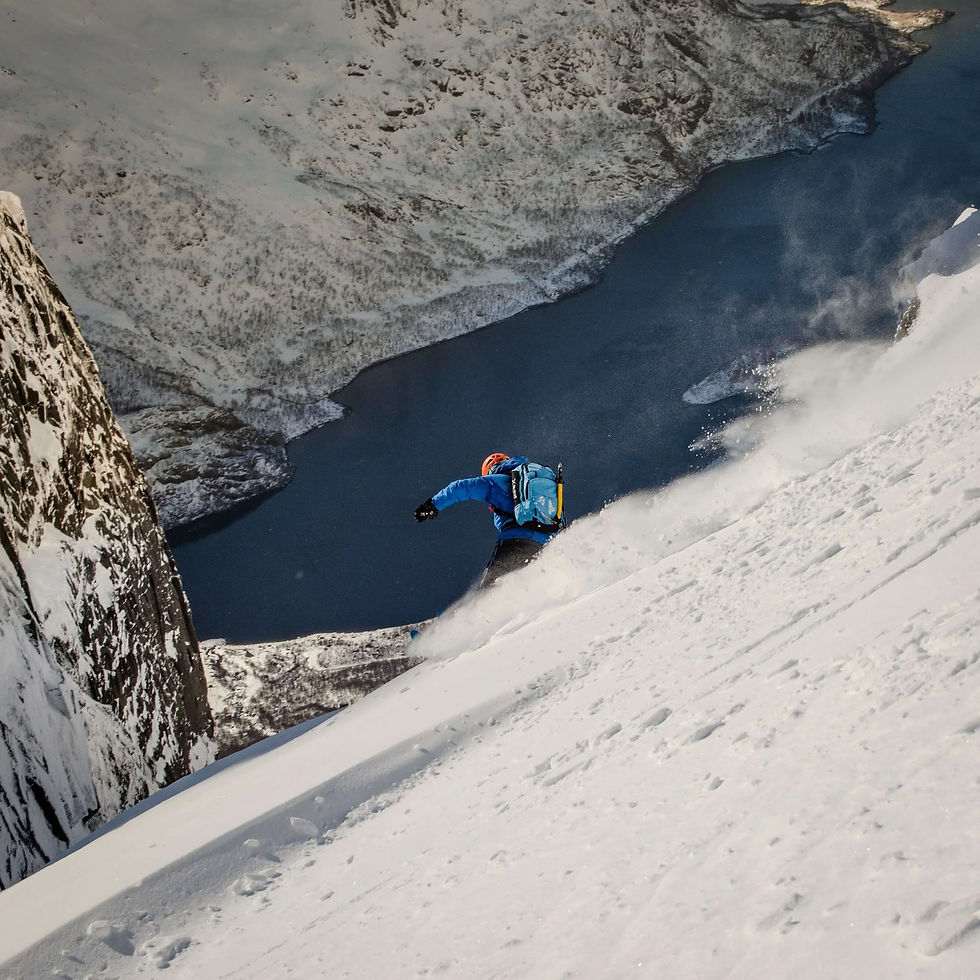
In March the sun never climbs high
There's one thing photos don't carry: the light. At these latitudes, at winter's end, the sun stays low for a very long time. It grazes the horizon, draws the shadows out for hours and lays a colour across the snow that lingers from morning to evening. You climb into it, you ski back down into it.
The light calendar here is worth being straight about. Around mid-March, day and night even out — a dozen hours of daylight — and the light keeps gaining after that, which gives you the long April days. The northern lights, for their part, show from September to March: early in the season there are still nights dark enough for them to appear over the rorbu. By April the daylight has already taken everything back — you won't see them, and I don't sell auroras in April. If the lights matter to you, aim for March.
To pick the month that fits you, I've laid it out elsewhere: when to ski the far north, month by month. Our own departures sit in March and April.
What safety means out here
We ski real mountains, in avalanche terrain. The Norwegian warning service, Varsom / NVE, puts out a daily bulletin for the “Lofoten og Vesterålen” region, from 1 December to 31 May. We read it every morning; it steers the choice of route before we even get into the minibus.
Every skier heads out with the full set — transceiver, shovel, probe, airbag pack — provided for the week. The group stays small: six skiers per guide, three groups at most across the week. That's not decoration: it's what lets you back off quickly when you have to, switch aspect, turn for home. Reading a bulletin also means knowing when to turn around — I say so plainly in reading avalanche risk: when to turn back.

The level of skiing, no sugar-coating
Let's be clear so nobody ends up out of their depth. This isn't a mountaineering trip: no glacier, no technical crampon work, no altitude vertigo. But you need to be a strong off-piste skier, at ease in every kind of snow — cold powder, heavy spring snow, the odd crust — and fit enough to cover 700 to 1,000 metres of skinning in a day, several days running.
If you ski a clean line down untracked snow and the climb doesn't scare you, you're at home here. If not, better to know it beforehand. I've written a whole page on it, straight: the level it takes for an adventure ski trip. And if the idea of opening your own descents intrigues you, have a look at the honest ways to reach untracked snow.
All of it lives on the Lofoten ski safari trip page: eight days, six to seven days of skiing, the full detail.
Getting there, in two sentences
The trip routes through Oslo-Gardermoen, then Bodø, then Svolvær; the local airports are Svolvær (SVJ) and Leknes (LKN), with Harstad/Narvik-Evenes (EVE) as the other gateway, around 2 hr 30 by road. The detail of the flights and connections — schedules, layovers, the margins to leave yourself — deserves its own article, one I'll publish shortly; for the airports, the official source stays Avinor.

In brief
Where · The Lofoten archipelago, northern Norway, 68th parallel, north of the Arctic Circle
Format · Ski safari, single base in a rorbu at the fjord's edge, private minibus, a different island each day
Length · 8 days, of which 6 to 7 days of skiing
Season · February to April, heart of it in March–April; PowderWeGo departures in March and April
Vertical · 700 to 1,000 m of skinning in a day
Group · 6 skiers per guide, three groups maximum
Level · Strong off-piste skier at ease in all snow conditions, sound fitness; no mountaineering, no glacier
Safety · Full transceiver, shovel, probe, airbag pack provided; daily Varsom bulletin
Questions people ask me
The best month to come
Between February and April, with the heart of the season in March–April. Our departures are in March and April. March for the winter powder and the chance of the northern lights; April for the long days and the spring snow. The month-by-month detail is here.
The level of skiing expected
A strong off-piste skier, at ease in every kind of snow, fit enough for 700 to 1,000 metres of skinning a day. It isn't mountaineering, but it isn't a first trip off the piste either.
How much vertical in a day
Between 700 and 1,000 metres of skinning, usually in a single climb, since you set off almost at sea level and come back down to the edge of the fjord.
Do you see the northern lights?
In March, yes, it's possible: there are still dark enough nights. In April, no — the daylight has already taken everything back. Nobody can guarantee an aurora, but if they matter to you, choose March.
Do you ski all the way down to the sea?
Yes, often. Since you click in almost at the fjord's edge and ski that same line back down, the runs regularly finish in the sea.
A word from Boris. Lofoten is the trip I suggest to anyone who has already had a taste of the backcountry and wants something other than a single valley to circle around in. You come back to the same cabin every night, you set off somewhere else every morning, and it never wears thin. If you want to see whether the terrain suits you, write to me — we'll talk about your level and the month that will fit. The whole trip is on this page. — Boris Malesset, founder of PowderWeGo
Also worth reading


Comments